
Good News About Cleaning Some Handguns

By MARJ LAW
“What?” Ellen shrieks, horrified. “You’re telling me that I have to clean my gun every 2-3 months? I heard I only have to clean it every 2 years or more!” She crosses her arms over her chest and glares at me for giving her such unwelcome news.
“Besides,” she adds defensively, “It doesn’t deserve to be cleaned more often than that. The bullets keep nose-diving on me. That’s what the guy next to me at the Wakulla County Sheriff’s Office range called it. He saw how I had to keep dropping the magazine. And I was careful to keep the muzzle pointed downrange while I did it, too. Then I had to jiggle the gun upside down so the bullet would fall out of that hole.”
“The bullet never even got into the barrel! So, that’s why my .380 doesn’t deserve to be cleaned. It keeps jamming up on me! Maybe I’d clean it more often if the darn gun worked better.”
“You really do have a great gun,” I assure her. “And the good news is you’ve done just the right thing in remembering to drop that magazine first because you noticed something has gone wrong.”
“And keeping the muzzle pointed downrange? Yes, it sure is kind of a trick to remember to do that as you’re trying to shake the cartridge out of the ejection port. But you remembered to do both things.”
“The bad news is that your gun has been crying out for a good cleaning! Sometimes there’s so much shooting residue on the ramp that the nose of the bullet is unable to slide up the ramp. Since it can’t go up the ramp, it stays cock-eyed in the ejection port. Its nose is now at the bottom of the ramp, and its hiney is sticking upwards.”
“Yes,” agrees Ellen. “That’s exactly it. Sometimes the casing is jammed at the top of the hole, and sometimes the whole cartridge is just skewed inside. Either way, the gun doesn’t fire.”
“Now for the good news, Ellen.”
“I don’t see much good about that.”
“Well, the good news is that you have one of the easiest handguns to take down when you want to clean inside.”
“I thought it would be hard. That’s another reason I haven’t wanted to clean my gun.”
“Yes, some handguns do require know-how, special tricks, and effort to take down. But your Smith & Wesson .380 EZ is not difficult at all. The Sig Sauer 365 and Sig 320 come apart in a similar fashion as does the Springfield XDM. The Heckler and Koch P30L and the H&K .45 do, too. The Glocks 42 and 43 have different take down tabs, but they come apart about the same, too. You just have to remember on those Glocks to pull the trigger first before field stripping. Other guns, too, come apart in a similar fashion.”
“Truthfully,” says Ellen, “I don’t care about other handguns. I just want to learn to take mine down.” She still isn’t thrilled about learning to fieldstrip her gun. “But, while you’re here, can we take it out on the picnic table and will you show me how?”
The picnic table outside is a good idea. Cleaning a gun involves using solvents that can ruin the top of your good dining room table. Trust me. My dining room table has had a cloud in its finish since I cleaned a gun 7 years ago. Someday, I’ll get to refinishing it. Some day.
First, I put down a cleaning mat on the picnic table and then place some wax paper over the mat to make cleaning up later easier. The wax paper isn’t necessary, but I like easy cleanup.
Then, Ellen makes a small tray out of aluminum foil to collect used cleaning materials. We have her collection of cleaning supplies at the ready along with some grease for the when the gun is finished.
“First, point the gun in a safe direction and dump the magazine,” I instruct her. “You already know how to do this. Push up the slide lock lever and lock back the slide. You know how to do this, too. Check the ejection port and chamber to make sure the gun is totally empty.”
“Now that the slide is locked back,” I continue, “locate the takedown lever. It is the lever closest to the muzzle of the gun. It has a few raised lines on it to give your finger some traction as you flip it downward so that it is now at a 90’ angle to the slide, whereas the lever was parallel before.”
Ellen pushes it down easily.
“Now you can push down on the slide lock lever to release the slide. At this point, you can pull the slide all the way off the frame of the gun.”
Ellen pushes the slide off the frame. “It came right off!” she exclaims proudly.
“Now the gun is in two parts: the slide and the frame. Didn’t think it would come apart so easily, did you?” I tease. Ellen grins.
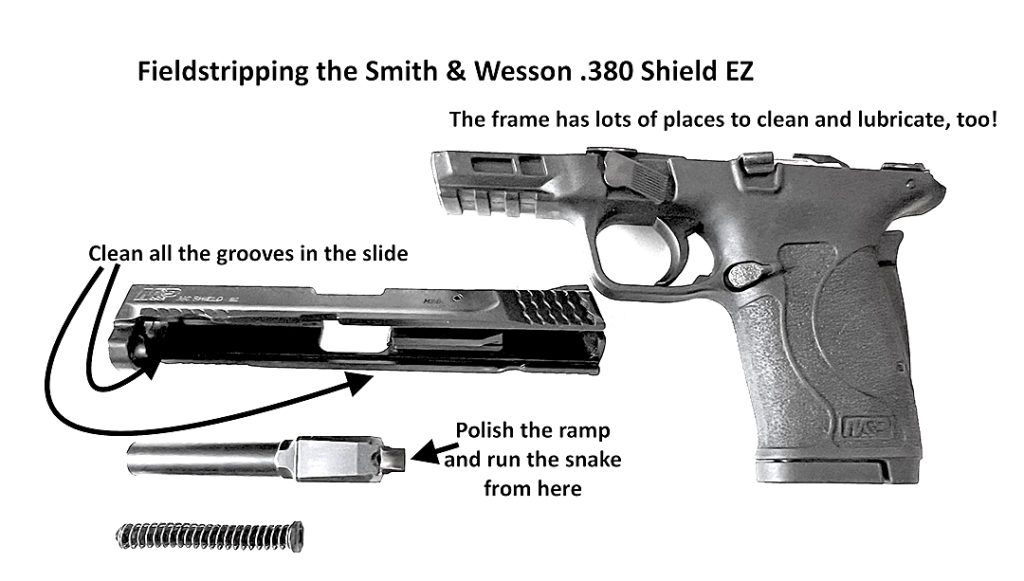
“Turn the slide upside down. Lift off the recoil spring and take it out along with the barrel.”
Ellen takes them apart.
“Look down the barrel. Notice all the black dots inside. That’s shooting residue. See the black tongue at one end of the barrel? That’s the ramp. It’s supposed to be shiny metal. The black is more shooting residue and has got to go, go, go.”
Ellen holds up the barrel and peers through it.
“I see the black dots,” she reports. “Can I use my snake to get rid of them?”
“Sure. Just remember to put the string side of the snake in first. Always enter the snake from the ramp side of the barrel. Make sure there are no knots in the snake.”
“Dampen the rough portion of the snake with solvent. Then, you’ll find it easiest to hold the barrel with one hand and drop in the string of the snake with the other, allowing gravity to help the snake slide through.”
“The snake doesn’t slide through all the way,” she informs me, and shows me that the stopped snake.
“Don’t be afraid to pull harder.”
Ellen tries again. This time, the snake passes through all the way.
“How do we get the ramp clean?” she wonders.
We take solvent and rub the ramp with a cotton swab. After using several swabs, the ramp still has a black spot that hasn’t come off.
“This Maas metal cream should help.” We rub and rub until the ramp shines.
“Shooting residue is corrosive,” I tell her. “It ate away a small etch on the ramp. Next time you clean, pay particular attention to this spot, as dirt will tend to collect here.”
“Drat,” she contemplates. “Looks like salt making a pit on silverware. I sure will have to clean it more often now that the surface has been scored with the black stuff.”
“Yes, that’s an important place to scrub,” I agree.
“So, can we put the gun back together now?” she asks hopefully.
“No. We haven’t cleaned or greased the rest of the slide or the frame.”
“Aren’t we finished?” Ellen wants this done now.
“Soak a cotton swab in solvent. Now, run it through this groove in the upside-down slide. See the gunk it collected?”
“Looks like mud,” she says.
“If you clean this EZ every 3 months or so, it shouldn’t get so dirty. Check your ammunition, too. Some ammo shoots cleaner than others. Once the EZ is cleaned and greased, it shouldn’t nose dive or jam any more. Next time, we’ll scrub out the rest of the gunk in the slide and the frame. Then, we’ll grease some important parts.”
“It’s not hard,” Ellen doesn’t sound so stressed now. “It’s like housework. Boring, but necessary. You can’t clean your house every two years, either.”
Note: We will finish the cleanup in next week’s article.
Marj Law is the former director of Keep Wakulla County Beautiful who has become an avid shooter in retirement.