

New to understanding semi-auto handguns

By MARJ LAW
Ella wants to purchase a handgun. She’s talking to her boyfriend, Sam.
“I went to a gun store while driving out of town. I wondered what would be a good idea to buy. The guy asked if I wanted a revolver or a semi-automatic. Since I don’t know anything about handguns, he said I’d need a revolver because they are simple to manage. Is that so, Sam?”
“Yes. That’s probably true. Do you know the difference between a revolver and a semi-automatic?”
“I think so. The revolver has that round thing in the middle of it.”
“Yes. That’s a cylinder,” he replies.
“And you put a bullet in each of its holes. Then you just point and shoot. That’s the easy one.
According to the guy in the store, with the other kind, you have to put your bullets in this job, then you have to stick it in the handle. You have to push down a lever so you can shoot. Then you have to pull the top of the gun backwards. After that, you can shoot.”
Sam winces. “Did the shop guy tell you how to clean the revolver or the semi-automatic?”
She frowns. “That’s another reason I don’t want a semi. You have to take it apart to clean it. You don’t have to do that with a revolver.”
“Well, Ella, you do have a little understanding of the two types of handguns. And it takes a while to become proficient with any gun. However, did the fella tell you that you only have 5 – 9 shots with the revolver, while with the semi you can have 6 – 15 shots, and even more? That’s particularly useful if you’re not terribly adept at shooting well. If you’re in a situation where you have to defend yourself, more rounds in the gun gives you more chances to keep the bad guy away.”
“That’s a lot less in the revolver than the semi.” Ella, who thought she had her mind made up, is not pleased.
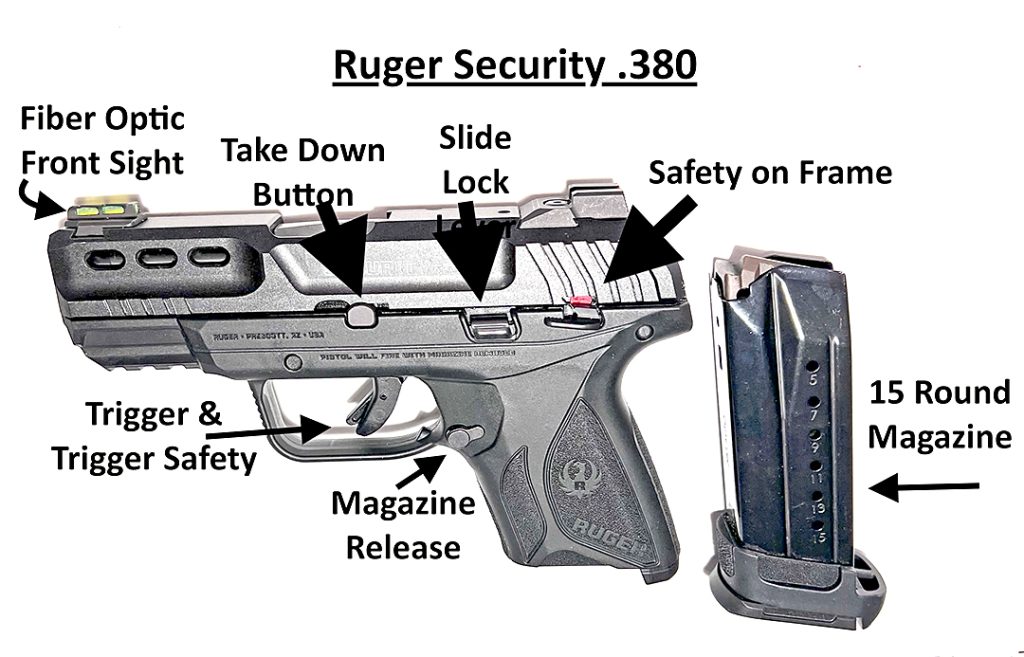
“Let’s discuss the semi-automatic handgun and a philosophy of basically how it works,” suggests Sam. He shows her a semi-automatic Ruger Security .380. “The Security comes with a 15 and a 10-round magazine. Quite a lot more rounds than a revolver, right?”
Ella nods.
“Where’s the hammer?” she asks.
“You don’t see a hammer because this gun has internal hammer.
First, you always assume the gun is loaded. Point your gun in a safe direction, even if you’re pretty sure it is empty, so that you never hurt a person or anything you might not intend to shoot.” He points the gun towards the forest.
“Next, you’re not putting ‘bullets’ in your gun; you put in ‘rounds.’ A bullet is just a part of a round. The entire round is composed of a casing having powder in it, and then the projectile which is the bullet. So, when you want to have ammunition, you ask for ‘rounds’.” He picks up a round and shows her the casing and the bullet.
“You put your rounds into a magazine, then you slide the filled magazine into the grip of the gun.” He picks up a magazine and pretends to push a round into it with his thumb. “Then you pull the slide backward which is called ‘racking’ or ‘jacking’ the slide. This is important because when you do this action, it loads the first round into the chamber.”
He pulls back the slide. “It’s not so difficult, is it?”
Ella shakes her head. “Then you pull the trigger?”
“Almost. We’ll discuss proper range conduct at another time. You’ll want to be at a range where it’s safe to shoot. You’ll have both hearing and vision protection. When the range is declared “hot,” you’ll aim the gun. On the top of the gun are ‘sights.’ You align the sights to aim, and then you squeeze the trigger. See the sights?”
He points out the sights of the Ruger. Ella nods.
“There are many different sights on the rear (the part closest to you) and the front. This gun has a ‘U’ shaped rear sight and a green fiber-optic front sight.” Sam shows Ella the sights.
Placing the gun on the table in front of them, he points to the trigger.
“You already know that this is the trigger.” Ella nods again.
“This lever, usually on the ‘frame’ or ‘lower’ part of the gun, is a safety. When it is in the ‘up’ position, your gun will not shoot. When you are ready to shoot, you push this lever down. Some guns do not have a safety here. Some safeties are on located on the ‘upper’ or the ‘slide.’
“Some guns have a trigger safety, like this one. It looks sort of like another trigger, only it’s smaller. Some have safeties on the back of the grip. And some guns do not have safeties at all. Some guns have a long trigger pull. This long pull acts as a safety. When you have to pull such a long trigger, your shot is deliberate. This particular gun has 2 safeties: one on the trigger and one on the frame.
“Usually, you’ll find a button or lever near or right on the grip. This is your magazine release. See?” he asks Ella, pressing on the magazine release. The magazine shoots out of the grip.
Ella picks up the magazine and slides it back into the grip. Then she pushes on the magazine release, and the magazine shoots out again.
“I did it!”
“See this lever? It is in front of the safety. It is the ‘slide release’ lever. It can lock back the slide, so you can look in the chamber to see there is or is not a loaded round.” He locks the slide back, and she looks into the chamber.
“It also acts to aid in taking down the gun. Before you remove the ‘take down pin,’ you need to lock the slide back.
This last pin is the ‘take-down’ pin. When you learn how to activate the take-down pin, or lever in other guns, it serves to release the slide so you can remove it from the frame. The slide has a recoil spring and a barrel. You take these parts out in order to clean the gun. After cleaning, you replace the barrel and the spring. Then you align the slide’s rails with the rails on the lower and move the slide back into place.”
“That’s a lot to remember!” exclaims Ella.
“But remember, this gun holds 15 rounds. That’s a whole lot more than the revolver.
When you’re in danger, do you want 5 or maybe 9 rounds in your gun, or do you want 15?”
“I think I’ll learn to handle a semi-automatic handgun,” concludes Ella.
Marj Law is the former director of Keep Wakulla County Beautiful who has become an avid shooter in retirement.