

2 Sig Sauer Handguns: P226 and P229

By MARJ LAW
I usually discuss firearms which are lightweight, concealable and have little recoil, because these are qualities that newer shooters or mature shooters find most useful for them. However, the Sig Sauer P226 and P229 are two handguns that have performed well for decades in military and law enforcement and have stood the test of time.
These two Sigs are not light and not concealable. They are full-sized service pistols. The P226 was used by Navy Seals in the 1980s. The P229, a somewhat shorter and lighter version of the P226, was “adopted by numerous militaries and law enforcement agencies worldwide. I always thought of it as the ‘Secret Service’ gun. Designated the M11 by the U.S. military, the P229 was intended as a compact sidearm for soldiers who needed a more concealable weapon,” according to Dave Luu of guns.com.
The P226 and the P229 are what we are shooting this Wednesday at the Wakulla County Sheriff’s Office range. They are 9mm handguns. They are both hammer-fired, double-stacked and have Siglite night sights. They are not ambidextrous.
On the left side the controls are: a decocking lever, a slide stop and a magazine release. The decocker acts as a safety. When you press the decocking lever, the hammer is lowered, but not all the way. Internal parts bar the hammer from striking, so that the firearm can be carried safely with a round in the chamber. The double action trigger is heavy, so that the shooter must make a deliberate decision to pull the trigger. Following single-action shots are faster and lighter.
These guns are full-sized and heavy; especially the P226. This gun is 7.7 inches overall, with a barrel of 4.4 inches. It is 1.5 inches wide and it weighs a whopping 34 ounces. That’s more than 2 pounds! With the weight combined with a deep beavertail, the P226 sits firmly and securely in the web between your thumb and index finger. This also helps to hold the gun in position when firing, making for more accurate shooting.
The flip side of the P229’s size is, according to Foghorn on The Truth About Guns is that while it fits large hands: “I carried this gun (concealed, IWB) for well over a year, and it was massively uncomfortable. It was like having a boat anchor in my pants, dragging them down. I actually had to buy my pants a size or two larger just to fit the thing inside. It’s one of the reasons I eventually switched to OWB carry, and I haven’t looked back.” (IWB means inside the waistband. OWB means carrying outside of the waistband in a holster.)
The P229, meant to be more concealable, is somewhat shorter and weighs less than the P226. This was more convenient for those needing to carry a gun. While it is still full-sized, it weighs less at 29.6 ounces. It is 7.1 inches overall, with a shorter barrel of 3.9 inches.
Both the P226 and the P229 have double-stacked magazines. The P226 comes with 3 15-round magazines and the P229 comes with 3 10-round magazines. Larger magazines are available for both handguns.
Double action trigger pulls of these guns are really sturdy; in my opinion, downright hard. With the Lyman Digital Scale, the P226 we are shooting at the WCSO range averages out to 10 pounds 15 ounces trigger pull in double action and 5 pounds 12 ounces in single action. Remember, in double action, the trigger must both cock and then release the hammer. In single action, the trigger only releases the hammer.
The P229 averages out to 10 pounds 12 ounces in double action with 5 pounds 9 ounces in single action.
Both guns are proven to be robust and reliable. Their control placement is similar, and the weight of both helps with stability and accuracy. Since they’ve been used for decades, accessories are available for both.
The negatives seem to be that the controls are not ambidextrous, and that both are wide and heavy for concealed carry.
Bottom line question is: how do they shoot?
At the range this Wednesday, Joe and I are shooting both in single action. Will the somewhat heavier gun with its longer barrel give the P226 an advantage over the lighter P229 with its shorter barrel?
Usually, the heavier handgun has more mass to absorb recoil. Recoil causes the gun to move off target. Will we find the heavier P226 to be more accurate than the lighter P229?
We decide to shoot 4 rounds in each gun, using 115-grain Monarch steel-cased rounds on 8-inch targets. We’re shooting in single action. The hammer has been cocked, and there is a round in the chamber. We want to compare how hard the triggers are, and how long they travel. We’re feeling shooting the gun to determine how much recoil we perceive in each. Subjectively, we question the comfort of the grip. Finally, we jack the slide to see how easily it moves.
Certainly, we will experience both differently because Joe is big-boned and he has large hands. I’m small-boned with small hands.
First, I pick up the P226. With its weight and with the deep beavertail, it quickly nestles into the web of my hand. Balance feels secure and even. I make sure to have a firm grip, and squeeze the trigger.
Blam! My 4 shots hit the 8-inch target at 7 ½ yards. On a 1-5 scale, with 1 meaning easy and 5 meaning difficult, I give trigger pull and travel, kick and grip all to rate 2s. Yes, the mass of the P226 does seem to calm the recoil. The gun shoots smoothly. I find the grip to be wide.
Joe shoots the P226. He finds the trigger pull to be lighter than I did. Not surprising, because he is stronger than I. He also finds the recoil lighter for the same reason. The grip is wide and long, which is better for his big hands, so he gives the P226 1 ½ scores for trigger pull and recoil. He gives the grip a 1.
Now, we’re off to the P229. I find trigger pull and recoil to be heavier than the P226. Without the P229’s deep beavertail, grip and control are not quite so comfortable.
Joe finds the P229 to have a heavier trigger pull and recoil than he did the P226, but finds the guns to have slight, but hardly noticeable differences. He likes the grip on the P229 as well as he did the P226.
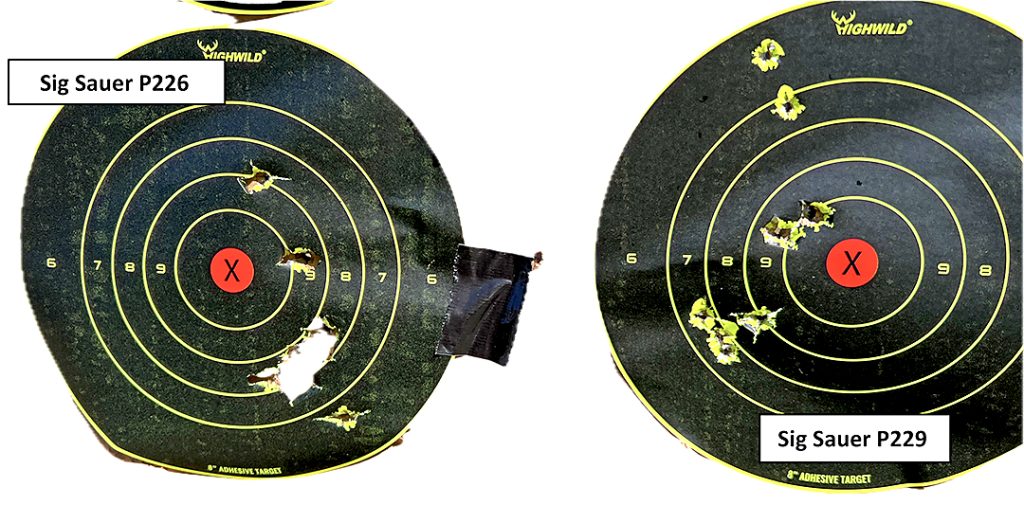
All of our bullets hit the 8-inch targets. The target you see on the left is the P226 target and the P229 target is on the right. The P226 target shows a tighter grouping, while the P229’s is slightly more scattered.
In conclusion, both handguns have proven to be reliable for decades with military and law enforcement agencies. Both guns would do well as home-defense or guns to be carried in the car. If you’re a big person, the P229 might be a gun to carry concealed, but the P226 is probably too large and heavy for a carry gun.
As a small person, I wouldn’t carry either gun. There are plenty of smaller and lighter handguns to carry concealed and there are plenty of 9mm handguns available that shoot well and are reliable.
However, as summed up by David Luu on guns.com about the P229 which would also relate to its forerunner the P226: “Anyone who wants a traditional double action in this size will find the P229 robust, reliable, and accurate.
Time and combat have proven this.”
Marj Law is the former director of Keep Wakulla County Beautiful who has become an avid shooter in retirement.