

The Browning Hi Power vs: the Springfield XDM

By MARJ LAW
There’s something to be said about a tried and true handgun of the past and one of the new-fangled guns of today.
Firearms inventor John Browning designed the Hi Power handgun. Although he died in 1926, the gun was completed by Dieudonne Saive at FN Herstal. The gun finally went into production in 1935.
Guns in the 1920s didn’t have a large capacity for rounds in the magazines at the time, so the 13-round Hi Power became widely used in the military. In fact, FN called it the “Hi Power” “in allusion to the 13-round magazine capacity, almost twice that of other designs at the time.” This handgun, according to Wikipedia was: “one of the most widely used military pistols in history, having been used by the armed forces of over 50 countries.”
Joe, who heavily appreciates Browning’s handguns and their history, came across a 9mm Browning Hi Power in one of our local gun shops.
“It’s a real Hi Power,” he breathes as he looks through the case. “I’ve never held an original. This one was made in 1979. It’s part of history.”
Of course, he had to hold it. And then, of course, he really wanted it. He was so hooked.
“No.” I had to put my foot down. “We do not need another gun.”
“But it’s one of Browning’s finest designs,” he wheedles.
“No. We can’t afford it, and we don’t need it,” I remind him. “No.”
He gives back the gun, his hands holding tight until the shop owner pulls it away.
“It’s a collector’s item,” he moans. “It even has… (dramatic pause) beer barrel sights! I believe only about 3 guns have ever been made with beer barrel sights!”
I make a point to stare at the sights. Yes, they’re a huge improvement over traditional military sights, which are usually a groove in the rear and a ramp in the front.
“Those sights are even adjustable on both windage and elevation!” he tells me with great enthusiasm. “It’s a true antique! It was made in 1979!”
Yes, sure, those adjustable sights must have been a huge improvement instead of those military sights. But that still doesn’t mean we need this particular handgun.
No.
For the next 3 weeks, I keep hearing the merits of the Browning Hi Power. By then, I expect the gun to be sold, but I find my way back to the shop.
Sure enough, the Hi Power is still there. I guess it was meant to be. Drat.
With Christmas more than half a year away, I purchase the gun and hide it in my underwear drawer. The downside of keeping it a secret gift is that I have to listen to Joe dropping heavy hints about the wonders of the Hi Power and how it isn’t made any longer and how this particular handgun is in nearly perfect condition and how he’ll probably never see another original Hi Power in such great shape. And… And…
I pretend to stand firm. One day, he visits the gun shop to find the gun is no longer available.
“Guess it wasn’t meant to be,” I say cheerfully, but it was difficult to see his downcast face.
Of course, he got the gun as a Christmas present. He was very happy with it, and still is.
“I know it’s a piece of history and a John Browning gun and all that, but don’t you think the guns of today are better shooters?” I ask him.
“No,” he replies with assuredness. “The Hi Power is made of metal; not of polymer material. The Hi Power was made with great precision. They don’t make guns today like they did back when Browning was alive.”
“Well, you know, Joe. I beg to differ with you. Take the Springfield XDM you bought me years ago. For one thing, it’s a striker-fired gun. You know I prefer striker-fired guns.”
“That’s purely subjective,” he replies. “I prefer hammer-fired guns.
“Okay. Well, I do like that we had a trigger job on it. The trigger pull is light and trigger travel is short.”
“True. But that wasn’t original to the gun,” he argues.
“Mebbe not, but the grip is great with the way it is cut so there are grooves for your thumb and index fingers. Very ergonomic.”
“Okay. You got me there. The grip is narrower and not so boxy as the Hi Power.”
“It’s lighter than the Hi Power,” I remind him.
“True. But not by much.”
“The Springfield has a grip safety. You don’t have to remember to check if the safety is on or off.”
“True,” he agrees again. “But you can carry the Hi Power ‘cocked and locked.’ You cock the hammer and then pull the manual safety lever up. Flip the lever down, and you’re ready to shoot. And, in the meantime, the gun will not fire. It’s a great safety measure.”
“Let’s take them to the range,” I suggest. “Then we’ll find out if historic guns are better than new ones.”
“Sure,” he agrees. “But first, let’s compare these 2 guns.”
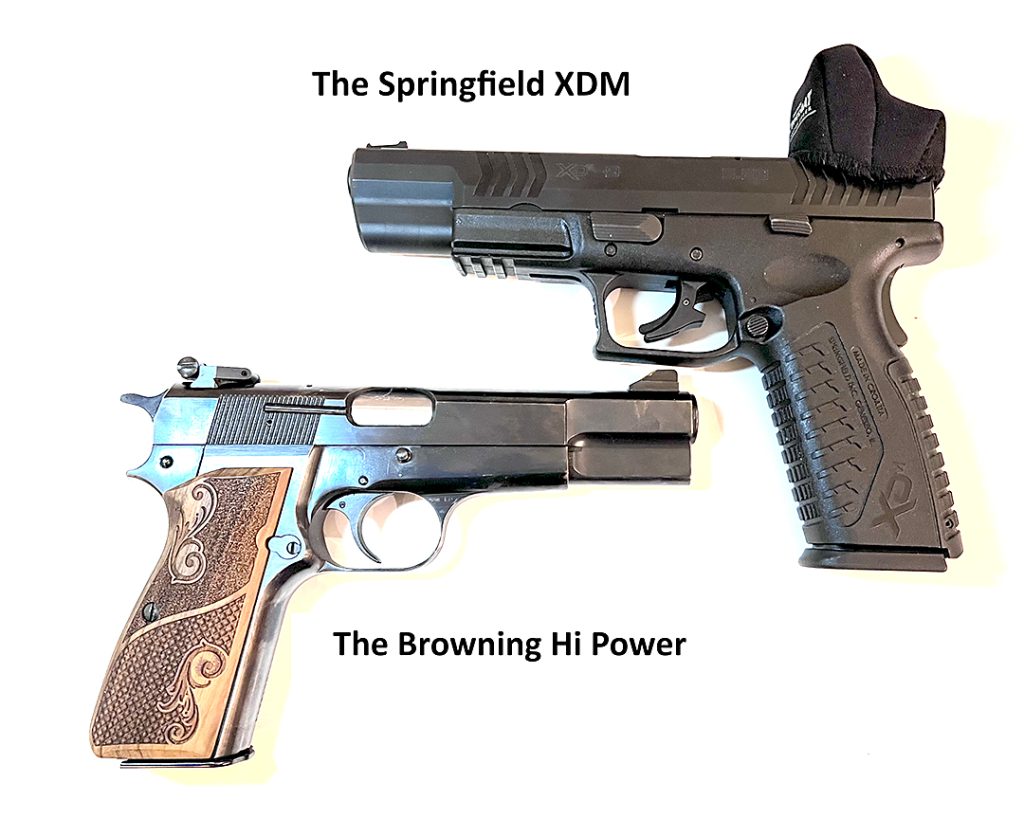
We measure and weigh. The guns are fairly similar in size. The Hi Power is 7.8” long overall and weighs 31.5 ounces. The barrel is 4.7” long. Originally, the gun came with magazines holding 13 rounds, but in the fairly recent past, magazines will fit that hold 15 rounds.
The Springfield, also a 9mm gun, is 8.3” overall and weighs 29 ounces. The barrel is 5.25” long. Although I have several 19-round magazines for it, I use the 15-round magazines to give a more fair comparison. Joe puts a 15-round magazine in the Hi Power, too.
We bring both handguns to the Wakulla County Sheriff’s Office range.
Using 124-grain rounds, we shoot 5 rounds each into the 8” targets. First, we have to cock the hammer of the Hi Power because it is a single action only gun. Once cocked, we need to pull back the slide. I find the slide very difficult to manipulate. Joe, with his large hands and bigger bones, finds the slide much easier than I do.
We shoot all 5 rounds.
Since Joe worked on the trigger, we find it to be light. Trigger travel is short.
I find the recoil to be substantial. Joe finds it sturdy as well, but again, due to his size and strength, he finds it easier than I do.
Even Joe finds the grip to be wide on the Hi Power. It’s really quite wide for me.
Next, we shoot the Springfield.
After loading the magazine, I pull back the slide. It is easy and slick.
We put a red dot sight on it. I vastly prefer a red dot sight to lining up front and rear sights.
Since we had the trigger lightened, it is very light and short indeed.
Recoil on the Springfield is substantially lighter than the Hi Power.
The Springfield’s grip is narrower than the Hi Power, making both of us decide the grip is more comfortable.
The Springfield’s trigger, trigger travel, ease of racking the slide, grip and recoil are easier than those of the Hi Power.
But somehow, and I can’t explain it, there’s something about the well broken-in action of the Hi Power. It’s smooth, like butter. Somehow, it shoots slick.
The Hi Power or the Springfield?
The Hi Power is a bit of history, and worn “cocked and locked” is safe and useful as a service pistol.
The Springfield is a great range gun and fine for competition.
They are both fine handguns.
Marj Law is the former director of Keep Wakulla County Beautiful who has become an avid shooter in retirement.