

Percusssion to cartridge

By MARJ LAW
In spite of the rain yesterday, someone left something by the front door. Was it from our friend Amazon?
No. This is the double-barrel portion of an old shotgun.
“How old is it, would you guess?” I ask Joe.
He thinks for a moment.
“Probably about 100 years old.”
“Who left it here?”
“I don’t know.”
After calling a few friends, we haven’t discovered who left us this interesting part of an old shotgun. So, between looking at it myself, asking Joe questions and checking the internet, I’ve learned some things about it.
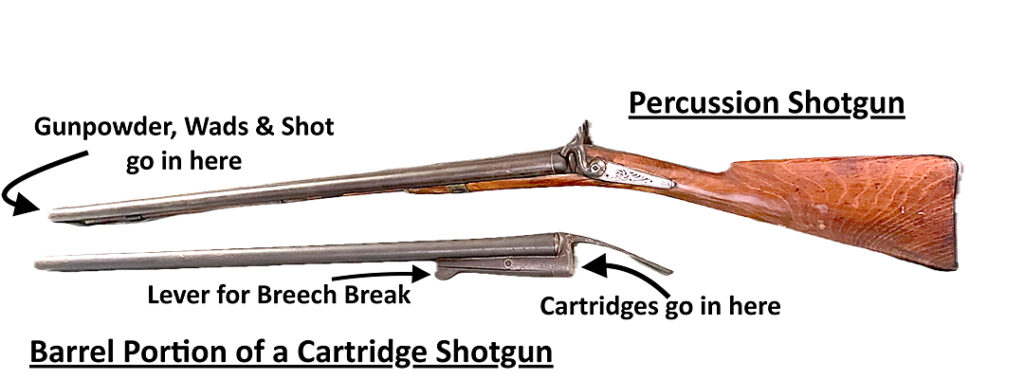
First, it is not part of a muzzle-loading gun, where you feed gunpowder and a wad of shot down the muzzle. The “mystery” barrel we found at the door has a breech assembly on it. We’ll call it the mystery gun throughout this piece. Maybe someday, a person will call to tell us who left it with us!
In this gun, you can open the breech and put in a cartridge into each barrel. Cartridge guns like this came after muzzle-loading percussion shotguns.
According to Wikipedia of cartridge shotguns: “In the 1840s and 1850s the percussion cap was first integrated into a metallic cartridge, where the bullet is held in by the casing, the casing is filled with gunpowder, and a primer is placed on the end. By the 1860s and 1870s, breech-loading metallic cartridges had made the percussion cap system obsolete.”
“Wow. These barrels really must have come from a shotgun over 100 years old!”
To show me the difference between percussion and cartridge guns, Joe brings out an old percussion shotgun. It has two barrels, side by side, like the mystery gun. It has two hammers. Put the load in the barrel, and fit a cap over the nipple. The hammer hits the cap, which makes a spark that sets off the gunpowder you’ve placed down the muzzle and then added a wad, the shot and another wad to keep the shot in. The gunpowder goes off, sending the shot out of the gun.
This mystery gun part that was left at the door has a breech-break lever under the barrels. You turn the lever and at this point, the metal breaks apart so that you can place a cartridge in the breech of each barrel. The gun would have had two triggers like its predecessor: the percussion gun. The forward trigger is assigned to the right barrel and the back trigger goes to the left barrel.
The mystery gun would have had two hammers like the percussion gun. Instead of having caps to set off the gunpowder, each hammer would have a firing pin that would hit the center of the cartridge that was placed in the barrel at the breech break. When the hammer is cocked, and the trigger is pulled, the firing pin whacks the center of the cartridge.
The center of the cartridge is where the primer is located. The primer is the charge which, when whacked by the firing pin, ignites the gunpowder in the cartridge. Shot is located within the casing and flies out when the gunpowder is ignited. The size of the shot put in would depend on the size of the game.
“The guns are different, but you can see the progression in technology. What was the main use of this shotgun, and how far could it shoot?” I ask Joe.
“This is the kind of gun a farmer would have kept by the door or above it for easy access. He would hunt game like rabbit, pheasants and grouse. Shooting would be accurate from around 30 – 40 yards.”
“How do they shoot?”
“These guns are both single-action only. Remember, in single action, the trigger has only one job. It releases the hammer. You have to cock the hammer before you can shoot. Since you must cock the hammer manually, you don’t need a safety. The gun will not fire by itself.”
“Several years ago, I wrote about Damascus steel barrels. Both the percussion shotgun you have and this mystery barrel seem to have lines circling the barrel. Are they both made of Damascus steel?” I ask Joe.
“Yes,” says Joe. “Although there is lots of finely pitted oxidation on these barrels, you can see the lines showing the layering of Damascus steel.”
According to Mizoguns.com: “The layered construction consists of different types of steel, which greatly enhances the barrel’s strength and flexibility. For example, high-carbon and low-carbon steels are often combined, creating barrels that can handle the high pressures generated when a shotgun is fired. This combination of aesthetic beauty and practical utility is what makes Damascus barrels truly exceptional.”
So, back around the late 1800s and the turn of the century, Damascus barrels are known for their elegant appearance. I read they were relatively lightweight (although I picked up the mystery barrels and they feel heavy to me!) and the construction of these barrels was said to have absorbed some of the recoil.
“Could we shoot the gun, if we locate the missing parts?” I wonder.
“Probably not,” Joe replies. “First, to finish the gun, it will need a stock, a trigger assembly, hammers and side plates to hold the hammers. Even if we find these pieces, modern ammunition is too strong for the older barrels, which used black powder. Furthermore, the welding of the metals may have weakened with age. You can even see that the steel has thinned with time and use. Also, since the exterior of the barrels has a patina of oxidation, who knows how badly the barrel might be
“Drat. I guess this means that even if we find the rest of the gun, we won’t be able to shoot it. But it might be fun to keep an eye out for the parts and put it back together again.”
“We’ll see what we can find. This would make a great wall-hanger. Together with the percussion gun, we can have a visual history of the development of shotguns from percussion to cartridge.”
Marj Law is the former director of Keep Wakulla County Beautiful who has become an avid shooter in retirement.