
How to Tell Striker or Hammer-Fired Handguns

By MARJ LAW
“I’m planning on buying a gun!” announces Liza. “Kimmy was afraid of looking stupid buying locally because she knew nothing about guns, so she went to an out-of-town gun shop. She figured that she could learn by asking a lot of questions. Trouble was, when she returned home, she talked to her husband.”
“What’s wrong with that?” I wonder, thinking her approach sounds like a good beginning. “The more questions you ask, the more you’ll learn.”
“Well, her husband didn’t like what she ‘learned.’ He got mad because she was considering buying an Airweight .38.”
“What was the gun guy’s rational for her to have that particular gun?”
“He said it can fit in her purse, is pretty, can come in a color to match her clothes, and will impress her friends!”
“Is that what made Dave get angry?”
Liza thinks for a moment.
“No. That just made Dave snicker. Even Kimmy thinks those reasons are pretty dumb. But Kimmy went to learn, so she wanted to reflect on what the guy had to say.”
“Since they both had a laugh over these comments, why was Dave angry?”
“She was kinda proud to tell Dave about 3 types of guns: revolvers, striker-fired guns and hammer-guns.”
“So far, I’m not hearing what made Dave upset.”
“She thought she’d discovered something of interest. She told him how striker-fired and hammer-fired are engineered differently.”
“And that made him angry?”
“No. He said: ‘Show me.’”
“He unlocked his Kimber .45 and brought it to Kimmy. She showed him how she could tell it was a hammer gun because it has a dooflotchy sticking out the back of the gun. That’s the hammer. He didn’t agree or disagree, so she went on to say that when you find a handgun that has a smooth back with no dooflotchy, that makes it a striker-fired gun.”
“Where is this store she went to?” he asked. “Remind me never to shop there. I don’t have time to give that guy lessons.”
“What’s wrong?” She asked him. “Now I know the difference between striker and hammer-fired guns.”
“But Dave says she doesn’t. His response kinda hurt her feelings. She was just trying to learn. So, why did he get all bent out of shape?” she asked me.
“Sometimes, even at gun shops, you might get some incorrect or partial information,” I reassure her. “Usually, he’s right about the ‘dooflotchy’ or hammer. Yes, you can often see it protrude on the back of the gun. Even NRA Women says: ‘It is easy to distinguish a hammer-fired gun from a striker-fired gun. The hammer-fired has a visible hammer at the rear of the slide.’ However, this is not necessarily true. Some hammers do not stick out. These hammers are internal.”
“That’s not fair.” Liza’s a little miffed. “So, if it’s a hammer gun, and you don’t see the hammer, then how can you tell if it has one?”
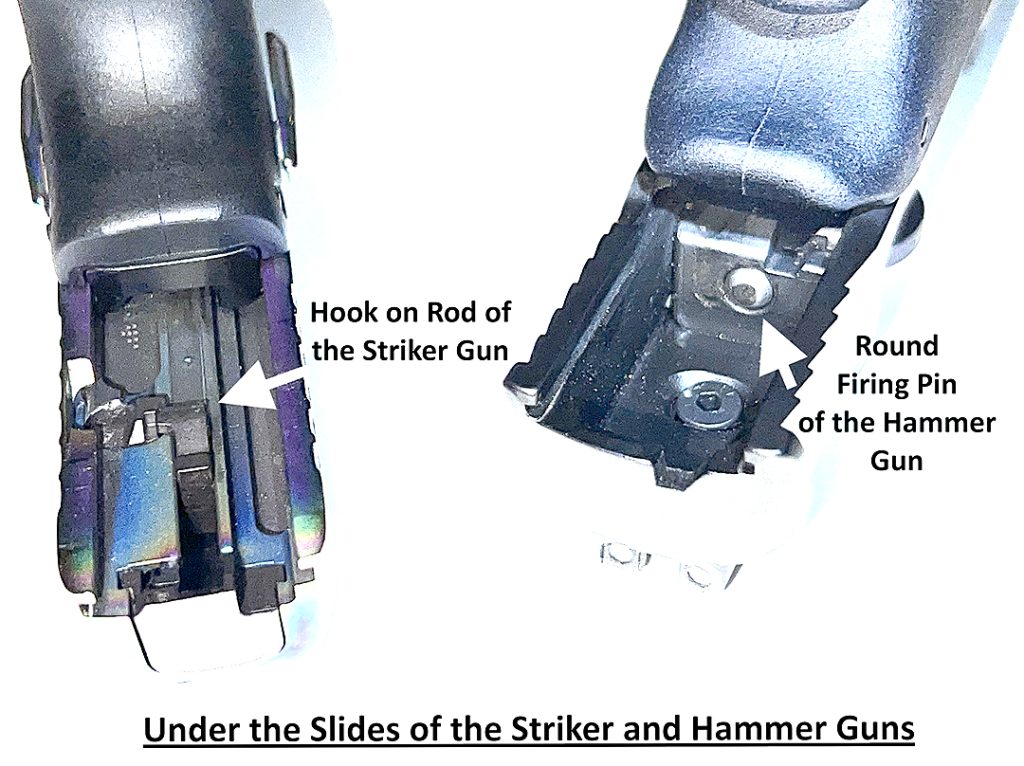
I bring out my Smith & Wesson Equalizer. After dropping the magazine and then checking the chamber to make sure there is no ammunition in the gun, I lock back the slide. Turning the gun upside-down, we look at the underside of the slide. This is where we can see a shiny round piece of metal. This is the back of the firing pin.
“When loaded, and the trigger is pulled, the hammer hits the firing pin which in turn whacks the primer of the 9mm round in the Equalizer. This ignites the primer of the round sending a spark to set off the gun’s powder causing an explosion to send the bullet out of the gun.”
“So, I look for this round thing?” she asks.
“Yes. Although you can’t see the hammer, you can see the end of the round firing pin.”
“How can you tell then, if it’s a striker or a hammer-fired gun if the gun has the internal hammer? Is there a firing pin in the striker-fired gun as well?”
“Let’s lock back the slide on the P365 .380. Do you see the round back of a firing pin?” I ask her.
“No. This looks entirely different,” she muses. “There’s a sort of rod with a hook that sticks up a little.”
“Exactly. Instead of a firing pin, there’s a striker. As Classic Firearms states: ‘A striker is a simple spring-loaded rod that impacts the primer causing a round to fire.’”
I continue: “It’s sort of like pulling the knob on a pinball machine. Pull it back, and when you let go, the compressed spring uncompresses, thus whacking the marble, allowing it to fly. Pew Pew states: ‘In the striker-fired gun, the trigger mechanism grabs the striker which pulls against spring tension, then releases (the) striker which flies forward. The front of the striker is a pin which hits the primer.’”
“Either striker or hammer, something has to hit the primer of the round so that it causes a spark to ignite the gun powder. You’ll see the round end of the firing pin on a hammer gun. You’ll see the rod with the hook on the striker-fire gun. What you really can’t see is the rest of the striker just like you can’t see the rest of the firing pin of the hammer gun. However, while the slide is still pulled back, look into the ejection chamber. You’ll see a piece of metal with a round hole in the center. Both firing pin and the front of the striker mechanism have round tips which jab through this hole to hit the primers of the guns.”
Liza looks at the two guns.
“So, which is better: striker or hammer-fired?” she wants to know.
“It all depends on which works best for you. I prefer striker-fired handguns. I like that they are simple to use. The travel of the triggers may be a little long, but I’ve found them to be pretty light to pull. I like that most striker-fired guns don’t have safeties. Classic Firearms says: ‘many self-defense encounters end in seconds, and this speed could make the difference between life and death.”
“When Mr. Bad kicks the door in, I know I’ll be very scared. I do not want to worry if the safety is on or off: I just want to remember to pull that trigger.”
“Does Joe prefer striker-fired guns, too?” she asks.
“No! Joe learned to shoot a hammer gun when he was in the Navy. That was many years ago and he has had a lot of practice. He learned to push down the safety fast with his thumb, so he doesn’t worry if the safety is on or off. He also prefers the smooth triggers of the hammer gun.”
“He will concede though, somewhat reluctantly, that some of the striker-fired guns do have good triggers, too. A few years ago, I dragged him to the dark side. I found him a Sig Sauer P320. It’s a striker-fired gun.”
“And he likes it.”
Marj Law is the former director of Keep Wakulla County Beautiful who has become an avid shooter in retirement.