
Simple Action

By MARJ LAW
“Look, Marj, all I want is a point and shoot gun. I don’t want to think of anything else. If Mr. Bad comes and breaks down the door, point and shoot is all I want. Now, you’re telling me that my Charter Arms Pit Bull can be shot in single action or double action. I want the Pit to shoot only one way. I looked for something simple and that’s why I got a revolver.”
Learning about revolvers is more complicated than just point and shoot. Mary is frustrated because her husband, Tom, said she should have a handgun. A revolver, he said, is the easiest gun to handle. Just pop each round into each chamber, and the 9mm Pit Bull is good to go.
Now Mary has the gun in her hands and we’re at the Wakulla County Sheriff’s Office range.
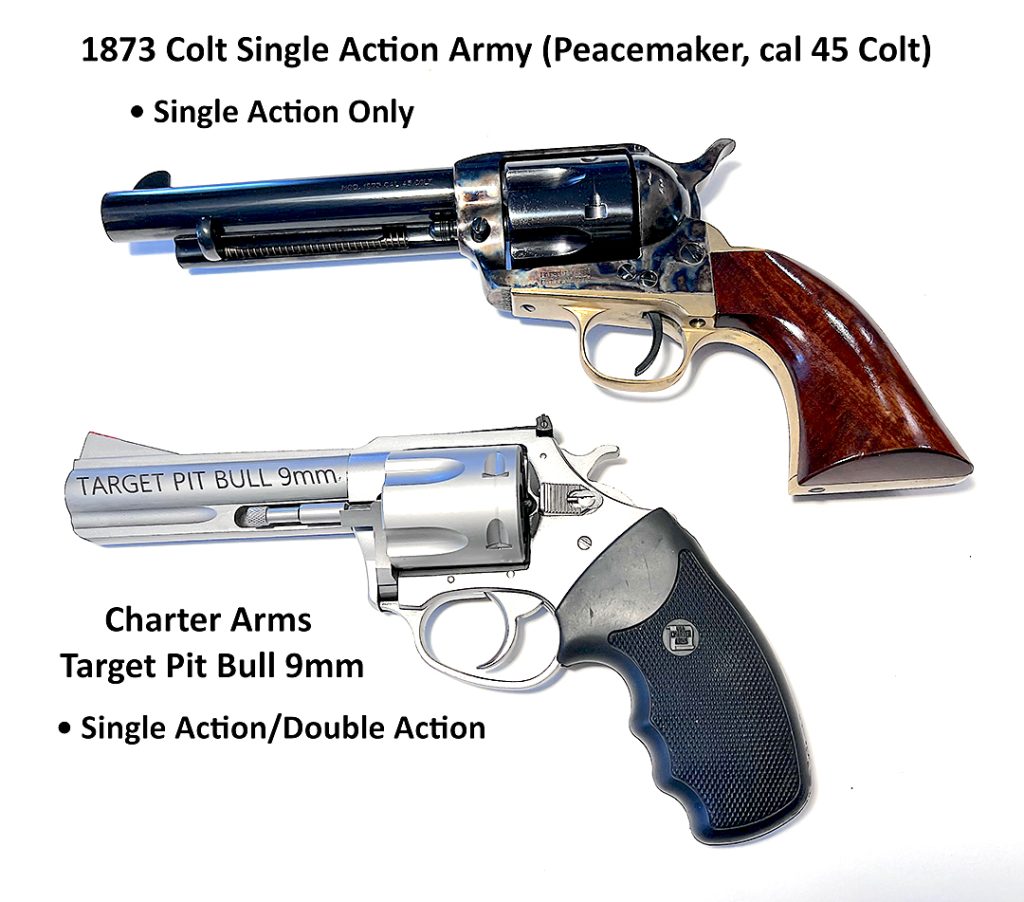
The range is “hot” and Mary is wearing her eye and ear protection. She knows to keep the muzzle of the gun pointing downrange.
She lines up the square back sights with the ramp front sight until the front sight nestles into the square of the rear sights.
“Can I shoot now?” she asks.
“Sure.” She has a firm hold on the rubberized grip with finger grooves. “Breathe in, then out. As you have breathed out, squeeze the trigger. Don’t yank it, but squeeze.”
Mary aims carefully. She breathes in, then out. I see her index finger move on the trigger.
“Nothing happens!” Mary frowns at me. “The gun doesn’t fire! I thought all I had to do is point and shoot. Well, I did and it doesn’t!”
“It will if you give the trigger a firmer squeeze. Your Pit Bull has quite a hard trigger pull. This is a safety measure. Your gun will not go off accidentally because the trigger must be pulled quite firmly. So, try again, but this time squeeze much harder, remembering not to yank the trigger.”
This time, when Mary pulls the trigger, I see her cheeks flex as she clenches her teeth. Pulling hard, her hands fly upwards as the gun finally fires.
“Wow!” she exclaims. “This gun sure won’t go off by itself! Just as you say, the trigger pull is much too hard for accidental shooting. I can see why Tom said I wouldn’t need a safety. It’ll be good luck if I can even shoot all five rounds!”
Now, Mary is discouraged.
“It’s sure not as easy as I thought it would be.”
“It’s a good gun, Mary. This time, keep your finger off the trigger. Now pull the hammer back. No, not half way. Pull it all the way back. Be careful to keep the muzzle pointed down range. Now, when you pull the trigger, it will be far easier.”
Mary looks like she doesn’t believe me, but she pulls the trigger determinedly.
Blam!
“Hey, Marj!” she is jubilant. “That was so much easier! I can shoot a lot this way!”
“This is that single action Tom was talking about. By cocking the hammer, you’re providing one action to get the gun ready to shoot. After you’ve cocked the hammer, pulling the trigger releases the hammer and the gun fires.”
Mary looks doubtful.
“Think of it like asking Tom to do the dishes.
Tom doesn’t like to do the dishes. Think of doing dishes as 2 jobs.
If you’ve scraped the dishes first, and you only ask Tom to load them in the dishwasher, he won’t dislike this job so much because it’s only half the work. You scrape and Tom loads. The trigger has two jobs also: cocking the hammer and then letting it go. This is double action.
But, when you cock the hammer like you just did, half the trigger’s work is done. Then the trigger only has the one job of releasing the hammer. Half the work is easier, so now it’s easier to shoot the gun.”
“I think I’m getting it,” said Mary. “Now, I want to watch Joe shoot 5 rounds by just pulling the trigger. That’s double action, right?”
“Exactly,” I encourage her.
“But then I want to watch as he cocks the hammer first, and see if he finds the single action thing a lot easier, too. I’d like him to rate the trigger pull on your 1-5 scale with 1 being the easiest and 5 the most difficult. I want to know if he finds double action a lot harder than single action, like I do.”
Joe is fine with this. He loads the gun, then aims and shoots.
“I’ll give the trigger pull and trigger travel a ‘4’,” he says thoughtfully. “It is a very firm pull.”
“Do you think it’s too hard?” asks Mary.
“No. If Mr. Bad broke your door down, your adrenalin would kick in big time, and you’d shoot that gun, no problem! But, if you’re at the range, you can cock the hammer first to make shooting easier. This will help you to get used to lining up your sights.”
“And dealing with the recoil,” adds Mary. “Even if I cock the hammer first, there’s still quite a bit of recoil.”
“That’s right,” agrees Joe. “You’ll learn both sight alignment and recoil management.”
“So, all revolvers are shot this way, right? You either cock the hammer first, or you don’t, but then you have a hard trigger pull.”
“Well,” says Joe, “The old Peacemaker was a single action revolver only. You always had to cock the hammer before you could fire.
In 1873, the Colt company had a contract with the Army to make their single action revolvers. But then in 1877, the first double action revolver was made.”
“Are revolvers all single and double action now?” asks Mary.
“Today most of them are. However, you can find Western revolvers in .22 and .22 Magnum and other calibers available today in that style. Remember the old movies where they ‘fanned’ the hammer? Fanning was cocking the hammer. Otherwise, you couldn’t shoot the gun.”
“I guess ‘fanning’ made for good movie drama,” thinks Mary. “But if I ever have to defend myself, I don’t want to worry about cocking the hammer first. That’s why I like my Pit bull. I can just aim and shoot.”
“But,” she adds, “I think I’ll practice at the range the easy way: by cocking the hammer first.”
Marj Law is the former director of Keep Wakulla County Beautiful who has become an avid shooter in retirement.