
Preparing to clean your handgun

By MARJ LAW
“It’s new. I won’t have to clean it for a while. Maybe a long while!” says newbie Annie.
She just purchased a brand-new Smith &
Wesson Shield 380 EZ. “And, when it’s time,” she continues, “I’ve bought a snake. You just put a bit of solvent on the snake and run it through the barrel. Presto! Easy peasy!”
Oh, if only it were true. Unfortunately for her, she’ll need to clean her new gun even before she visits the Wakulla County Sheriff’s Office range for the first time. Often, handguns come shipped with a heavy coating of preservative to prevent corrosion and rust. This means her gun needs to be taken apart and scrubbed to remove excess or it can degrade the gun’s action.
But fortunately for Annie, the EZ is truly easy to take apart and clean. First, Annie needs to collect the tools necessary to clean her gun both before using it and when it becomes dirty from shooting residue.
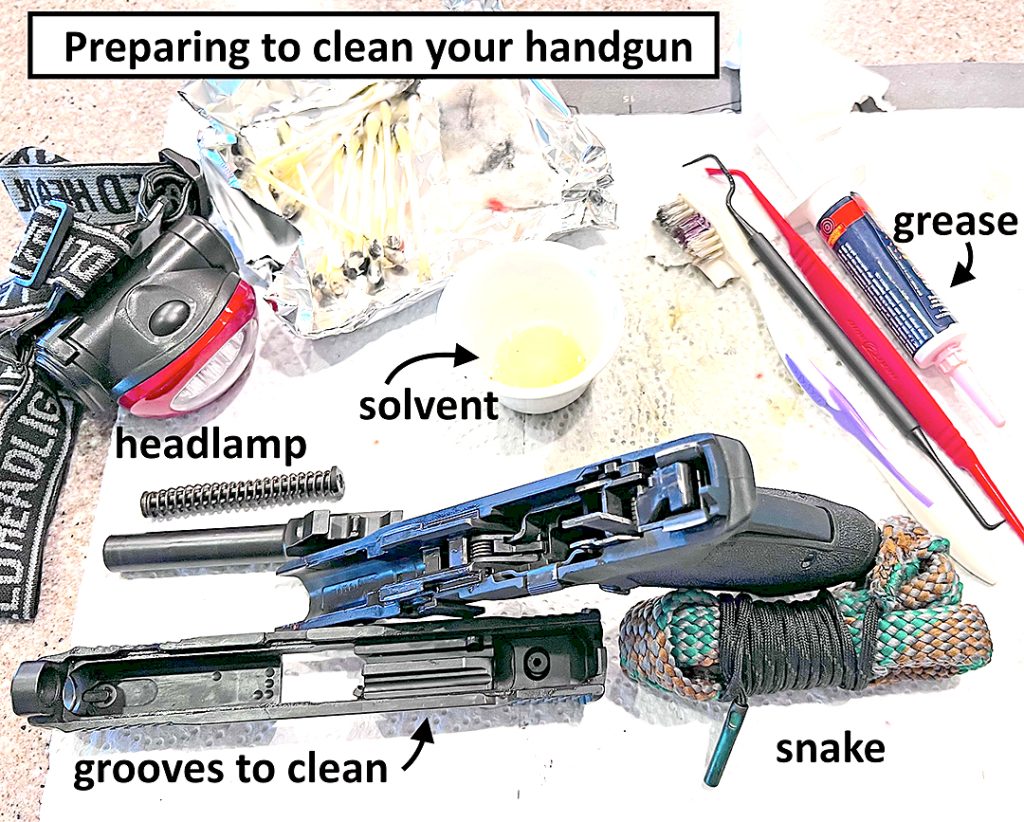
“OK. What do I need besides my snake?” she asks.
“First, where do you plan to clean your gun?” I ask.
“What difference does that make?” Annie wants to know. “The dining room table looks like as good a place as any.”
“The solvent you use will ruin the finish on your smooth cherry wood table. How about we go to the kitchen bar? Even Corian should be protected with a special thick mat made just for this purpose. Usually, I place paper towels over the mat to make cleanup easier.”
“OK, I’ll get a mat. They’ll have one at our local gun shop, won’t they?”
“Sure.”
“It can’t be too expensive. OK. The snake and the mat. That’s not much. But what’s this about solvent?”
“The solvent will clean off the protective coating on your gun.”
“Oh yes. My uncle uses something called ‘Hoppees.’ He says that’s the best.”
“Hoppee’s has been used for many years, but I’d go for a synthetic solvent.”
“Why? It works for Uncle Ben.”
“Many people find the vapors to be harsh and can cause allergic reactions like runny nose and watery eyes. The synthetics are easier to use.”
“OK. I’ll get the snake, mat and the synthetic solvent. Is that everything now?” Annie is sounding a bit bothered.
“Well, let’s take the EZ apart.”
“Why?”
“This will help you see where you need to clean a gun. Then you’ll get ideas for the tools you’ll want to have on hand. But first, we’ll point the gun in a safe direction, inspect the chamber, and drop the magazine.”
“Why? We know it’s unloaded.”
“For safety’s sake, you always check to be absolutely certain that the gun is unloaded. When you purchased the gun, the shop owner pulled back the slide to show you that the gun was unloaded, right?”
“Yes.”
“So, even though he knew it was unloaded, he double-checked and made sure you knew it too.”
“Yes.”
“This is a safety procedure that should always be followed.”
I turn the takedown lever 90 degrees. Then I show Annie how to remove the slide from the frame. We turn the slide upside down and take out the recoil spring and the barrel.
“What do you see?” I ask her.
“Not much! It’s kinda dark in there.”
“Another item you might want is a special headlight. This light will shine right down into your gun. It will help you see if there is any shooting residue or rust.”
“Is that expensive?” she wonders.
“It’s not too bad, and it will make cleaning your gun much easier.”
“Is that everything I’ll need to buy?” Annie is sounding a bit peeved.
“Well, you may want to purchase some plastic dental tools.”
“What for?”
“You see all these grooves? The dental tools will help to get the debris out.”
“This is getting to be expensive. Please tell me this is the end of our shopping trip,” she pleads.
“Other items you may need are things you have on hand at home.”
“Like what, for example?”
“Well, you can buy little cotton squares. They’re not expensive. But if you have an old cotton T-shirt, you can cut it up into 1-2 inch squares.”
“What are they for?”
“You can saturate the cotton with solvent, and use those new dental picks to push it into the tight places.”
“Anything else?”
“I bet you have plenty of cotton swabs at home.”
“Swabs?”
“Yes. Q-tips.”
“Sure. We have plenty of them. What are they for?”
“Like the dental picks, they’re also good at swiping in narrow spots.”
“Is that all I’ll need?”
“You may find that a toothbrush gets in those hard-to-reach places.”
“How do I know which to use? The dental tools, swabs or toothbrush (and it won’t be mine!)?”
“You’ll have to figure out what tools you like to use best. Then, I make a foil tray to place the dirty swabs and t-shirt pieces in.”
“OK. When I get done cleaning all these places in the slide, you’ll probably tell me to clean inside the frame, too. Then I’ll be done and can put the gun back together again, right?”
“Well, not exactly.”
“What else is there to do?” Annie is getting a bit overwhelmed.
“While the synthetic gun oil will clean, lubricate and protect your gun, a bit of gun grease will help in the rails to keep them sliding smoothly.”
“I think you’re hinting that gun grease is also on the shopping list.”
“Yes,” I reply. “My favorite comes in a syringe-like tube. The shape helps you slide it in the grooves of the rails.”
“If a little is good, more is better. Right?”
“No, Annie. You don’t want too much grease. Too much grease can attach to the shooting residue and gob up. You want just the thinnest coating of grease. You might even take a Q-tip and slide it over the grease in your rails. This can absorb any excess,” I reply.
“Looks like I need a small toolbox for cleaning my EZ. But now that it’s all cleaned up, can we put the gun back together and go to the range?”
Marj Law is the former director of Keep Wakulla County Beautiful who has become an avid shooter in retirement.