

Two of Browning’s famous handgun designs

By MARJ LAW
“It’s a Browning,” breathes Joe.
Oh. When I hear “It’s a Browning,” I know what’s about to follow. Joe will want to look at the gun. He’ll pull back the slide and peer into the chamber. He’ll drop the magazine.
“What comes with it?” he’ll ask.
Then I’m in trouble.
“We don’t need another handgun,” I object.
“Marj. It’s a Browning.”
Like that says everything.
This time, it’s the Browning Hi Power.
“It’s an original,” he says in awe. “It even has the beer barrel sights.”
He turns the gun to show me these unusual sights.
“I see.” I look at them closely. Wow. Rounded sights.
“It’s a collector’s item. Designed by John Moses Browning. Like that 1911 you have.”
“My 1911 is a .45-caliber Thompson Auto-Ordnance,” I disagree.
“Yes, but the design of your gun is pure Browning. The 1911 design was adopted by the US Army on March 29, 1911. That’s why so many handguns are called 1911s. They are based on Browning’s design. In 1913, the U.S. Navy and the U.S. Marine Corps also adopted the 1911-designed handguns.”
“But the gun you’re looking at isn’t a 1911,” I try to object.
“No, but it’s also designed by Browning.”
“So, we have a Browning and we don’t need another.”
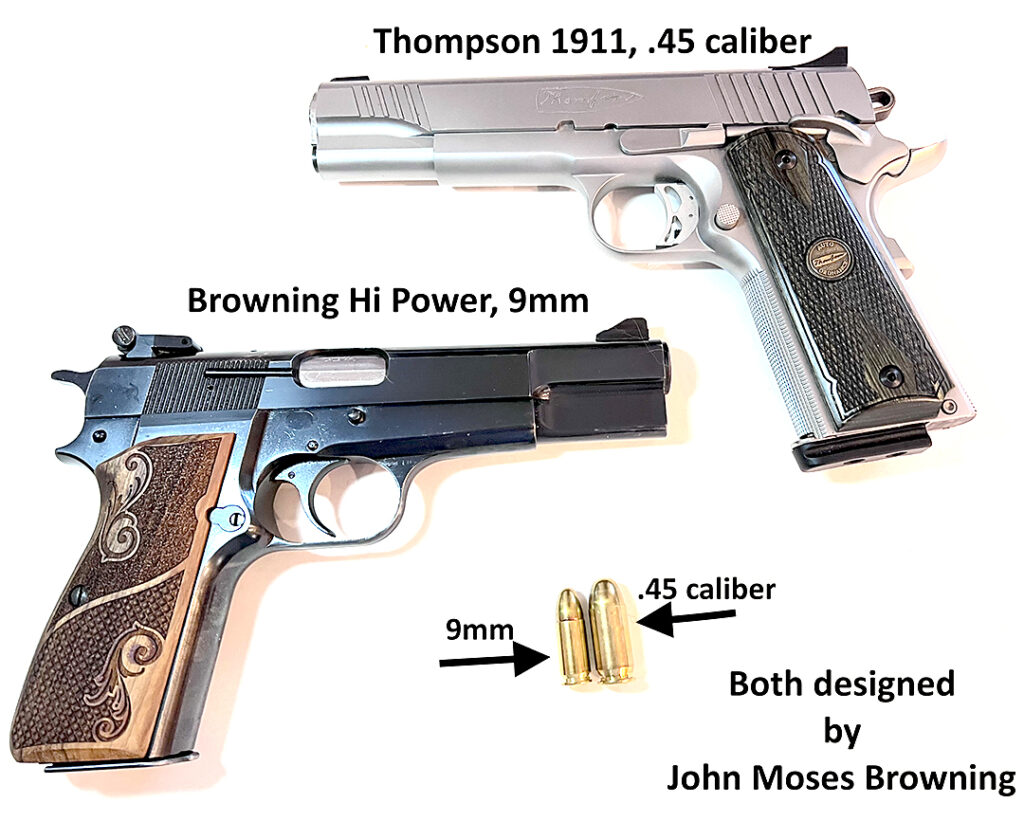
“The Hi Power is quite different,” he begins to explain. “Browning sold his patent to Colt. Later in 1921, France wanted handguns that could hold more rounds. They asked Browning to design one that could hold more rounds than the seven plus one round in the magazine of the 1911.”
“This is when Browning came up with the Hi Power. First called the High Power, the gun held 13 rounds and one in the chamber. “It was ultimately adopted as the standard service pistol by more than 50 armies. It has seen widespread use among military and law enforcement agencies in 93 nations,” according to Will Dabbs in The Armory Life.
“OK, so the Hi Power held more rounds than the 1911s. But today, you can get magazines holding 10 rounds in a 1911. With one in the chamber, I might add. If you’re looking for more rounds, the 1911 is now close to the Hi Power, and they’re both designed by Browning,” I argue.
“Ah, but now magazines have been made for the Hi Power that hold 15 rounds. With one in the chamber,” he adds.
You can guess what happened next.
Yes, Joe now has a Browning Hi Power. An original. Needless to say, he’s excited as we spend our usual Wednesday morning at the Wakulla County Sheriff’s Office range. We plan to compare shooting the two Browning designed guns: the Browning Hi Power and the 1911 Thompson Auto-Ordnance.
The range is hot, so we can take our guns out of their sacks. First, we examine each handgun. I can tell that Joe is going to find reasons why he prefers the Hi Power.
“I guess one of the reasons that the Hi Power holds more rounds is because the magazine is double-stacked,” I notice.
“Yes,” he agrees. “Not only does it hold more rounds, but the double-stack makes the grip wider and it fills my hand better.”
“I like the way my 1911 sits in my hand,” I say. “The beavertail is huge and the weight of the gun makes the web of hand fit right into that big beavertail.”
“The weight is fairly heavy,” he agrees. “If you wore it in a holster, it would weigh your pants down.”
“So would the Hi Power,” I retort. “While the 1911 weighs 39 ounces, the Hi Power weighs 32 ounces. They’d both make my pants sag. Both guns are made of metal. What’s the difference in barrel length?”
He pulls out a small tape measure.
“The Hi Power’s barrel is 4.7 inches long and the Thompson is 5 inches long. Not much difference there,” he adds. Then he checks the length of both guns overall.
He adds: “The Hi Power is 7.8 inches long and the Thompson is 8.6 inches long. So, the Thompson is longer and heavier than the Hi Power.”
“Well, I’m not going to be lugging them around. We’ll be shooting here, at the WCSO range. Shall we take five shots from each gun? The target on the right will be for the Hi Power, and the target on the left will be the Thompson. We’ll consider how long and how hard the trigger pull is with each handgun. We’ll think about recoil because everyone wants to know about how much kick to expect. Last, we’ll check for accuracy and see how tight the groupings are or if they even hit the target at all!”
We shoot at 8-inch targets at a distance of 21 feet.
Joe goes first. With the Hi Power, his shots are to the left of the x-ring. With the Thompson, one of his shots hits directly beneath the x-ring.
Then it’s my turn. I also shoot the Hi Power to the left.
“Joe, I think you need to adjust the sights on this gun, seeing as we’re both shooting left.” He agrees. (When I finished shooting, he did adjust the sights. Then he fired a few shots and they did end up in a tighter grouping in the center of the target.)
When I shoot the Thompson, groupings are fairly tight. I’m surprised, though, that recoil on the 9mm Hi Power seems sturdier than that of the .45 caliber Thompson. The 9mm’s sharper kick makes my shots more scattered. I wasn’t prepared for the amount of recoil, and ended up limp-wristing a couple shots. Eek! Nobody likes to be accused of limp-wristing!
“That’s because the 9mm has higher pressure. It’s moving at a higher rate of supersonic speed.” says Joe. “The .45 has lower pressure and is moving subsonic: about 850 feet per second.”
I have better control with the Thompson. I think that is so because of the lower pressure, and its heavier weight absorbs some of the recoil. The deep beavertail sinks firmly into the web of my hand. I like the narrower grip and the smoother trigger.
Joe is bigger-boned, and the sharper recoil of the Hi Power doesn’t faze him. He prefers the 9mm’s wider grip.
Both guns fire single action only. The hammer has to be cocked first, then the trigger performs the one action of releasing the hammer. Both have manual safeties, although the Thompson also has a safety in its grip. Unless the manual safety lever has been deactivated (and the grip safety of the Thompson as well), you won’t be able to pull the trigger.
Both the Hi Power and the 1911 are reliable. As Jim Dickson in Gun Mag says: “Reliability in the world’s worst conditions is where the M1911 A1 has no peer.”
Today, you can find magazines that hold more rounds than when the guns first came out. While the Hi Power holds more ammunition than the 1911, the 1911 is a more powerful weapon. Both guns are very ergonomic.
Browning’s designs have held up over time. As Jim Dickson concludes: “The M1911A1 was built to be the most reliable combat automatic possible and it was built to last. New designs come and go (and often go very quickly if shot much) but the M1911A1 remains the best. Do you really want to trust your life and the lives of your family to less?”
Marj Law is the former director of Keep Wakulla County Beautiful who has become an avid shooter in retirement.